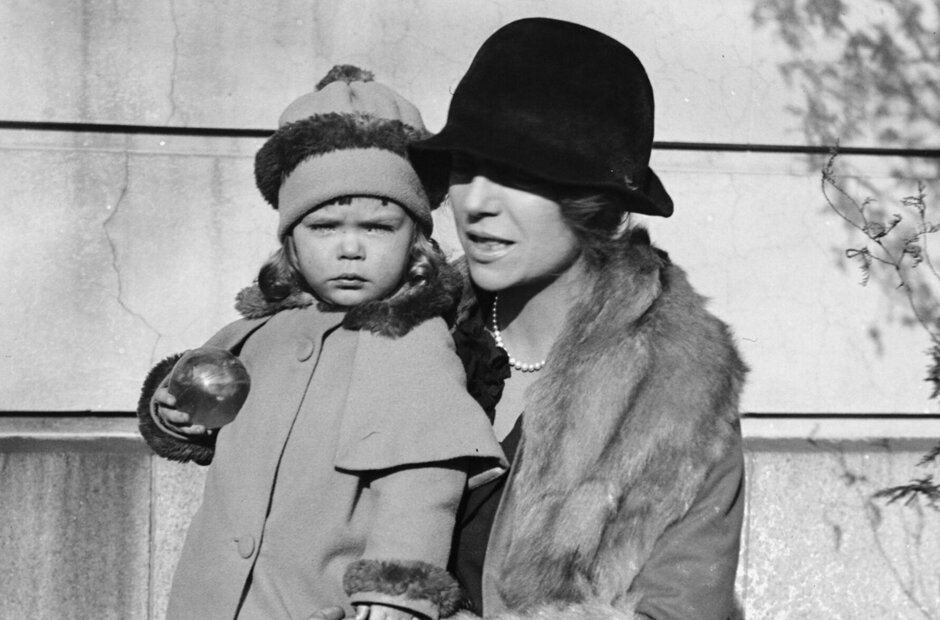
Basic Information
| Field | Detail |
|---|---|
| Full name | Paulina Longworth Sturm |
| Also known as | Paulina Longworth |
| Date of birth | February 14, 1925 |
| Place of birth | Chicago, Illinois |
| Date of death | January 27, 1957 |
| Age at death | 31 |
| Legal parents | Alice Roosevelt Longworth (mother) and Nicholas Longworth III (legal father) |
| Biological paternity | Widely attributed to Senator William Edgar Borah |
| Education | Brief attendance at Vassar College (withdrew after one year) |
| Spouse | Alexander McCormick Sturm (m. 1944; d. 1951) |
| Children | Joanna Mercedes Alessandra Sturm (born July 9, 1946) |
| Primary public roles | Socialite, volunteer; daughter and granddaughter within prominent political families |
| Burial | Rock Creek Cemetery, Washington, D.C. |
A Lineage of Power and Quiet Despair
Paulina Longworth Sturm was born into a map of American power—the granddaughter of a president, the only child of one of Washington’s most famous hostesses. Yet lineage and light do not always warm a person from the inside. Her life unfolded in the shadow of two overlapping narratives: one of political dynasty and social prominence, the other of emotional neglect and mounting private sorrow.
Her birthdate, Valentine’s Day, 1925, was linked to grief in the Roosevelt queue, predicting her bittersweet legacy. Paulina’s biological father is Nicholas Longworth III, although her mother’s relationship with Senator William E. Borah dates back decades. That reality, recognised in aristocratic circles, confused loyalty and attachment in ways that never fit familial norms.
She observed receptions, power plays, and social rituals that influenced national politics as a child in Washington, D.C. However, salon glitter could not cover quiet domestic spaces. Observers remember a rocky connection with her mother, who displayed sharp wit and social power but no love. Stuttering and extended silences showed inner stress, and a strict, remote upbringing left her pale in the bright world.
Marriage, Widowhood, and a Daughter’s Light
Marriage to Alexander McCormick Sturm in 1944 offered Paulina a season of real belonging. The union produced a daughter, Joanna, in 1946, and for a while the rhythm of family life replaced social scrutiny with domestic purpose. Alexander—an artist and an entrepreneurial spirit connected to a rising manufacturing enterprise—introduced a different stability into Paulina’s life.
That steadiness snapped. In 1951, Alexander died early, leaving Paulina twenty-eight and widowed. Loss revived wounds. Widowhood undermined her frail scaffolding: social functions resumed, maternal distance persisted, and sadness intensified into depressive episodes. With little personal comfort, she turned to Catholicism and volunteering to find ritual, meaning, and service.
Paulina poured devotion into her daughter. Joanna became the center of a mother’s care and the object of a grandmother’s attention after Paulina’s death; Alice, who had been distant toward Paulina, adopted and raised Joanna—some historians find in that reversal an added layer of sorrow for Paulina, who had long sought maternal approval.
The Slow Collapse: Mental Health, Attempts, and Tragic End
Numbers mark the arc of Paulina’s decline: born 1925, widowed 1951, dead 1957. In those six post-widow years she moved through therapy and religion, through volunteer projects and private attempts to manage a weight that would not lift. Her behavior included self-harm attempts prior to the final incident—facts that complicate any tidy classification of the final overdose.
On January 27, 1957, Paulina died from an overdose of sleeping pills. Contemporary accounts differ in interpretation: some labeled the death accidental, others pointed to the pattern of prior attempts as evidence of suicide. Either way, the outcome was tragically definitive: a life cut short at thirty-one, a single daughter left in need of care, and a public family forced to absorb a private calamity.
Public Image, Private Records, and the Absence of a Career
Paulina left no professional resume, unlike many public family scions. She avoided public service. After widowhood, she volunteered, converted, and slowly raised a kid in elegant surroundings. Family and her husband’s estate kept her financially secure, so she spent her days trying to fit into a social script that never fit.
The lack of a public vocation in itself became part of the narrative—an image of a woman whose identity was defined by relations rather than roles, by lineage rather than labor, by a private struggle that public pedigree could not conceal.
A Timeline in Brief
| Year | Event |
|---|---|
| 1925 | Born February 14 in Chicago |
| 1931 | Death of legal father, Nicholas Longworth III |
| 1944 | Married Alexander McCormick Sturm |
| 1946 | Daughter Joanna born (July 9) |
| 1951 | Husband Alexander dies (November 16) |
| 1951–1957 | Period of deepening depression, conversion, and volunteer work |
| 1957 | Died January 27 from sleeping pill overdose; age 31 |
Public Memory and Family Shadows
Paulina’s story reverberates not through headlines but through retellings—family biographies, historical footnotes, and occasional retrospectives that treat her as both emblem and casualty of a certain American aristocracy. She stands as a reminder that power and privilege do not inoculate against loneliness; that dynastic pedigree can coexist with private misery; and that human fragility often resides behind the most imposing facades.
A last irony: Alice, who had failed to nurture Paulina, raised Joanna. In a moral twist, the family’s public image was polished but its inner wiring remained twisted.
FAQ
When and where was Paulina Longworth Sturm born?
She was born on February 14, 1925, in Chicago, Illinois.
Who were her parents and who is considered her biological father?
Legally she was the daughter of Nicholas Longworth III and Alice Roosevelt Longworth; biological paternity is widely attributed to Senator William E. Borah.
Did she marry and have children?
Yes; she married Alexander McCormick Sturm in 1944 and had one daughter, Joanna, born in 1946.
What happened to her husband?
Alexander McCormick Sturm died in 1951 from viral hepatitis, leaving Paulina widowed.
How did Paulina die?
She died on January 27, 1957, from an overdose of sleeping pills; accounts differ on whether the death was accidental or intentional.
Was Paulina involved in public work or a career?
No formal public career is documented; she devoted time to volunteer efforts and domestic responsibilities.
What was her relationship with her mother like?
Their relationship was strained; Alice Roosevelt Longworth was noted for social dominance and emotional distance toward Paulina.